Friday, June 19, 2015

AMAZING ANIMALS OF CENTRAL AMERICA

An expected standard for fourth graders is to learn how to use multiple nonfiction resources to research and write an information report. In Proctor, the fourth grade decided to use this as an opportunity to integrate the subjects of social studies, science, technology and language arts. In 4K, we focused on Central America. We have been researching, planning, writing, editing and creating for quite a few weeks.
 As part of this country project, we researched animals found in Central America. The wildlife there is quite varied and very different from what we find around our country. 4K created a movie using i-movie and the green screen apps to teach everyone what we learned about the fauna of Central America.
Click on the picture.....
free glitter text and family website at FamilyLobby.com

Sunday, June 14, 2015

NAVIGATORS GAME

On June 10, all the students of  Proctor School were lucky enough to take a field trip to a North Shore Navigators baseball game. We not only saw a great game in which the Navigators won, but we were able to see the Proctor School Marching Band perform the Star Spangled Banner and Sweet Caroline during the 7th inning stretch. 
Our class connected this field trip to the standards by creating a book of idioms that originated from the game of baseball.
 Mrs. Kelleher's class 2015


Click on the links below to practice idioms and their meanings.......

4.L.4.5 Demonstrate understanding of figurative language, word relationships, and nuances in word meanings.

free glitter text and family website at FamilyLobby.com

Friday, May 29, 2015

SADAKO

Sadako
 TEN MOVES

CLICK ON THE LINKSTO SEE A BIT OF OUR PERFORMANCE


The fourth graders have all read the very touching story of Sadako and the Thousand Paper Cranes. It is an historical fiction book about a real little girl, Sadako Sasaki, who lived with her family when the atom bomb was dropped on Hiroshima at the end of World War Two. The story takes place a few years later when Sadako develops leukemia due the radiation lingering the air after the bomb. It teaches so many deep lessons about courage, hope, peace and strength.

To enrich this experience further,we spend a day with two talented artists who teach the students music and dances that relate the story and theme. This comes to us thanks to TESPTO.

Our class will perform along with Ms. Scott's class on Monday, June 1st. Students should wear black pants or shorts, sneakers and a white top.

We hope you are able to attend this heartwarming show. Parents should arrive at 2:00.
free glitter text and family website at FamilyLobby.com


Tuesday, May 19, 2015

"NOODLING IT OUT"

As we have been working on the rectangles and square unit in math these past two weeks, we have had an opportunity to really "noodle out" problems. We have had to persevere and persist to solve problems. These have been very important lessons, not just for math, but for life.
The essential questions we have been working with are:

"What are the properties of squares and rectangles?"
"How are rectangles and squares the same and how are they different?"
To explore these ideas more fully, we looked at the ancient problem of putting seven pieces together to form a square. Otherwise known as, Tangrams. Here we are working out some challenging problems.


Click on the puzzle to explore an incredible Tangram website.
free glitter text and family website at FamilyLobby.com

Tuesday, April 14, 2015

THE POWER OF ONE


As part of our study of main idea and themes in literature, we are reading Sadako and the Thousand Paper Cranes by Eleanor Coerr. This historical fiction book is not only a good lesson in history, but also in hope. The students really are enjoying it because of its  inspiring main character who is an actual girl who lived in Hiroshima, Japan when the atom bomb was dropped in an effort to end WWII.
Sadako Sasaki was two years old in 1945, but the story takes place when she is 11. She develops Leukemia due to exposure to radiation from the bomb, but never gives up her belief that she can defeat this disease. She starts folding paper cranes because of an old Japanese tradition that states if you fold 1000 cranes you will get your wish. Her story of perseverance through pain and illness to fold these cranes spread around Japan. Soon many knew of her story. 
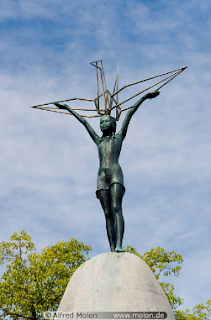
Sadako never did get her wish, but she did become a National heroine in Japan. She is Japan's symbol of peace. Students around Japan raised money to build a statue to honor Sadako and her message of peace and hope. There is an inscription at the base of the statue stating:

This is our hope
 This is our prayer
Peace in the world


The Common Core Standards we are focusing on are:

CCSS.ELA-Literacy.RL.4.1
Refer to details and examples in a text when explaining what the text says explicitly and when drawing inferences from the text.
CCSS.ELA-Literacy.RL.4.2
Determine a theme of a story, drama, or poem from details in the text; summarize the text.

Later in the year when we perform the Sadako Peace Dance with Nikki and Guy (sponsored by TESPTO), we will incorporate:
CCSS.ELA-Literacy.RL.4.7
Make connections between the text of a story or drama and a visual or oral presentation of the text, identifying where each version reflects specific descriptions and directions in the text.
free glitter text and family website at FamilyLobby.com

ELECTRIFYING ELECTROMAGNETS


Can you imagine turning something non-magnetic into something magnetic? Well, that is exactly what we did in 4 K. We turned an iron rod, a wire and battery into an ELECTROMAGNET. An electromagnet is a temporary magnet that allows you to control it. If you take a wire, wrap it around an iron rod and attach that in a complete circuit to a battery, you will make an electromagnet.


We wanted to see how the electromagnet would react when we wrapped the wire around the rod more and more times. The videos below will explain what we learned.


Our essential questions are:

1. How are electricity and magnetism related?

2. How can we make an electromagnets stronger?

3. How do you make a complete circuit?


Justin and Will


Click for Interactive Circuit Site

Tuesday, March 24, 2015

TECHSPLORATION IS TERRIFIC!

The fourth grade is studying electricity, circuits and magnetism. To enrich our curriculum TESPTO brought in Mr. Wahle and his TECHSPLORATION program. It started with a very interactive, interesting stage show where many concepts such as electrons flowing through a circuit and coils of wire wrapped around a metal rod creating an electromagnet were explored with students coming up and demonstrating each. He also showed us a Tesla Coil. (click here to learn more about Nikola Tesla.)
Then, each class was able to spend nearly an hour with Mr. Wahle in the lab creating circuits and exploring resistors, various switches, parallel versus series circuits and even telegraphs. 
The students were given a challenge to wire two or more users of electricity with different switches. A few groups were able to do this challenge. Here is what one group produced.


We all learned a great deal about electric circuits.


The physical sciences state standards covered just during TECHSPLORATION are listed below.

#6. Recognize that electricity in circuits requires a complete loop through which an electrical current can pass, and that electricity can produce light, heat, and sound.
#7. Identify and classify objects and materials that conduct electricity and objects and materials that are insulators of electricity.
#8. Explain how electromagnets can be made, and give examples of how they can be used.
free glitter text and family website at FamilyLobby.com