Friday, May 29, 2015

SADAKO

Sadako
 TEN MOVES

CLICK ON THE LINKSTO SEE A BIT OF OUR PERFORMANCE


The fourth graders have all read the very touching story of Sadako and the Thousand Paper Cranes. It is an historical fiction book about a real little girl, Sadako Sasaki, who lived with her family when the atom bomb was dropped on Hiroshima at the end of World War Two. The story takes place a few years later when Sadako develops leukemia due the radiation lingering the air after the bomb. It teaches so many deep lessons about courage, hope, peace and strength.

To enrich this experience further,we spend a day with two talented artists who teach the students music and dances that relate the story and theme. This comes to us thanks to TESPTO.

Our class will perform along with Ms. Scott's class on Monday, June 1st. Students should wear black pants or shorts, sneakers and a white top.

We hope you are able to attend this heartwarming show. Parents should arrive at 2:00.
free glitter text and family website at FamilyLobby.com


Tuesday, May 19, 2015

"NOODLING IT OUT"

As we have been working on the rectangles and square unit in math these past two weeks, we have had an opportunity to really "noodle out" problems. We have had to persevere and persist to solve problems. These have been very important lessons, not just for math, but for life.
The essential questions we have been working with are:

"What are the properties of squares and rectangles?"
"How are rectangles and squares the same and how are they different?"
To explore these ideas more fully, we looked at the ancient problem of putting seven pieces together to form a square. Otherwise known as, Tangrams. Here we are working out some challenging problems.


Click on the puzzle to explore an incredible Tangram website.
free glitter text and family website at FamilyLobby.com

Tuesday, April 14, 2015

THE POWER OF ONE


As part of our study of main idea and themes in literature, we are reading Sadako and the Thousand Paper Cranes by Eleanor Coerr. This historical fiction book is not only a good lesson in history, but also in hope. The students really are enjoying it because of its  inspiring main character who is an actual girl who lived in Hiroshima, Japan when the atom bomb was dropped in an effort to end WWII.
Sadako Sasaki was two years old in 1945, but the story takes place when she is 11. She develops Leukemia due to exposure to radiation from the bomb, but never gives up her belief that she can defeat this disease. She starts folding paper cranes because of an old Japanese tradition that states if you fold 1000 cranes you will get your wish. Her story of perseverance through pain and illness to fold these cranes spread around Japan. Soon many knew of her story. 
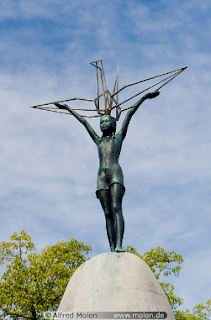
Sadako never did get her wish, but she did become a National heroine in Japan. She is Japan's symbol of peace. Students around Japan raised money to build a statue to honor Sadako and her message of peace and hope. There is an inscription at the base of the statue stating:

This is our hope
 This is our prayer
Peace in the world


The Common Core Standards we are focusing on are:

CCSS.ELA-Literacy.RL.4.1
Refer to details and examples in a text when explaining what the text says explicitly and when drawing inferences from the text.
CCSS.ELA-Literacy.RL.4.2
Determine a theme of a story, drama, or poem from details in the text; summarize the text.

Later in the year when we perform the Sadako Peace Dance with Nikki and Guy (sponsored by TESPTO), we will incorporate:
CCSS.ELA-Literacy.RL.4.7
Make connections between the text of a story or drama and a visual or oral presentation of the text, identifying where each version reflects specific descriptions and directions in the text.
free glitter text and family website at FamilyLobby.com

ELECTRIFYING ELECTROMAGNETS


Can you imagine turning something non-magnetic into something magnetic? Well, that is exactly what we did in 4 K. We turned an iron rod, a wire and battery into an ELECTROMAGNET. An electromagnet is a temporary magnet that allows you to control it. If you take a wire, wrap it around an iron rod and attach that in a complete circuit to a battery, you will make an electromagnet.


We wanted to see how the electromagnet would react when we wrapped the wire around the rod more and more times. The videos below will explain what we learned.


Our essential questions are:

1. How are electricity and magnetism related?

2. How can we make an electromagnets stronger?

3. How do you make a complete circuit?


Justin and Will


Click for Interactive Circuit Site

Tuesday, March 24, 2015

TECHSPLORATION IS TERRIFIC!

The fourth grade is studying electricity, circuits and magnetism. To enrich our curriculum TESPTO brought in Mr. Wahle and his TECHSPLORATION program. It started with a very interactive, interesting stage show where many concepts such as electrons flowing through a circuit and coils of wire wrapped around a metal rod creating an electromagnet were explored with students coming up and demonstrating each. He also showed us a Tesla Coil. (click here to learn more about Nikola Tesla.)
Then, each class was able to spend nearly an hour with Mr. Wahle in the lab creating circuits and exploring resistors, various switches, parallel versus series circuits and even telegraphs. 
The students were given a challenge to wire two or more users of electricity with different switches. A few groups were able to do this challenge. Here is what one group produced.


We all learned a great deal about electric circuits.


The physical sciences state standards covered just during TECHSPLORATION are listed below.

#6. Recognize that electricity in circuits requires a complete loop through which an electrical current can pass, and that electricity can produce light, heat, and sound.
#7. Identify and classify objects and materials that conduct electricity and objects and materials that are insulators of electricity.
#8. Explain how electromagnets can be made, and give examples of how they can be used.
free glitter text and family website at FamilyLobby.com

Tuesday, March 17, 2015

THE MIGHTY MIDWEST

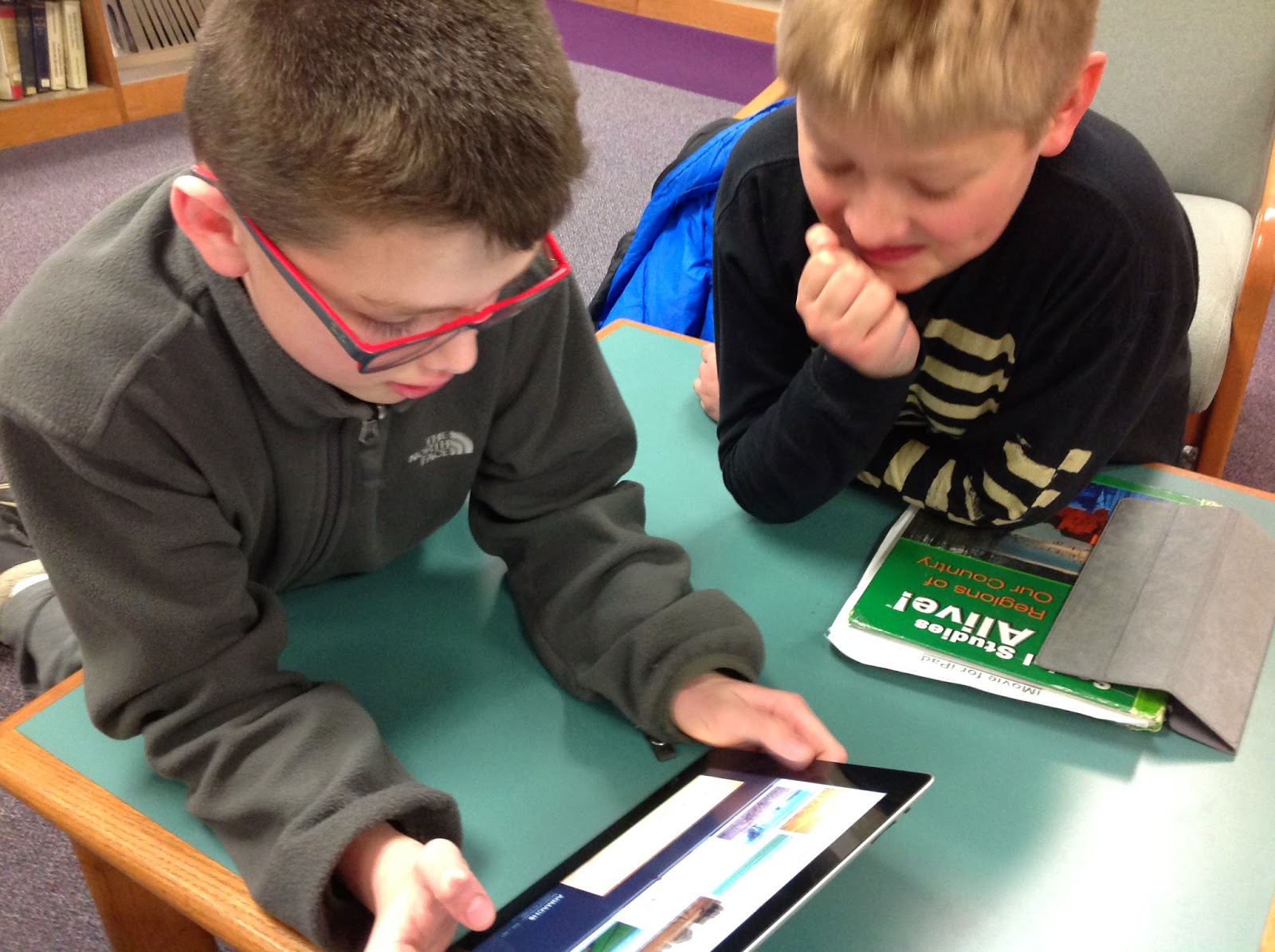
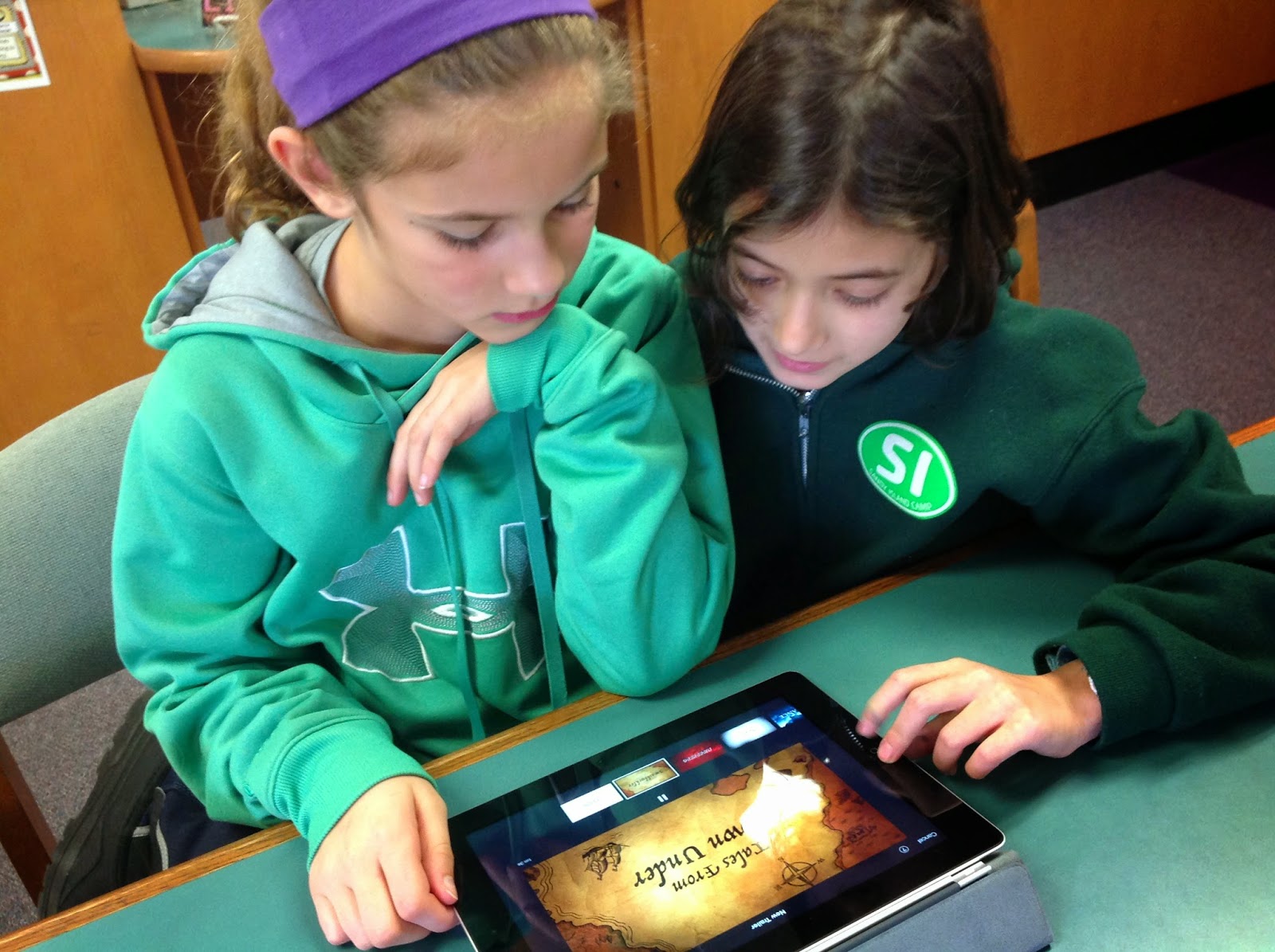
We used the app Movie Trailer to "wrap up" our study of the Midwest Region of our country. We took a tour of the region visiting places such as Mt. Rushmore and the Gateway Arch. More than that, we learned that this region is known as "The Breadbasket of America" because it raises most of the wheat and corn we all use. 
The students learned a great deal and to show all they learned, they broke into groups to create a movie trailer that summed up the main ideas they gleaned from our unit of study.
Our essential questions for this project were:
  1. How do you use the Movie Trailer app?
  2. How do you summarize what you learned about the Midwest into a Movie Trailer?
  3. What are the most important places and ideas to teach others about the Midwest?
Click on the photos below to watch the movie creations of 4K's students.


 Midwest Agriculture Changes

 Three Great Landmarks

 Midwest Missouri

 Midwest States and Capitals

 Landmarks of Illinois and Indiana


Sports of the Midwest
free glitter text and family website at FamilyLobby.com

Monday, March 16, 2015

The Value of the "Place"

It's the place that matters! We have been working on decimals which are part of our base-ten number system. The students were asked to represent mixed numbers as decimals using the base-ten blocks. In this case, the "flat" was used to represent one whole. We used the sticks and cubes for tenths and hundredths. The number below shows 3.6 (three and six-tenths). The students also wrote the numbers in expanded form below the block representation.
Our essential questions for this unit are:
How are fractions and decimals related?
How do we write and show decimals?
How do we write decimals in expanded form?


Here is a site you can use to play some decimal review games. Just click on the words.